
Introduction
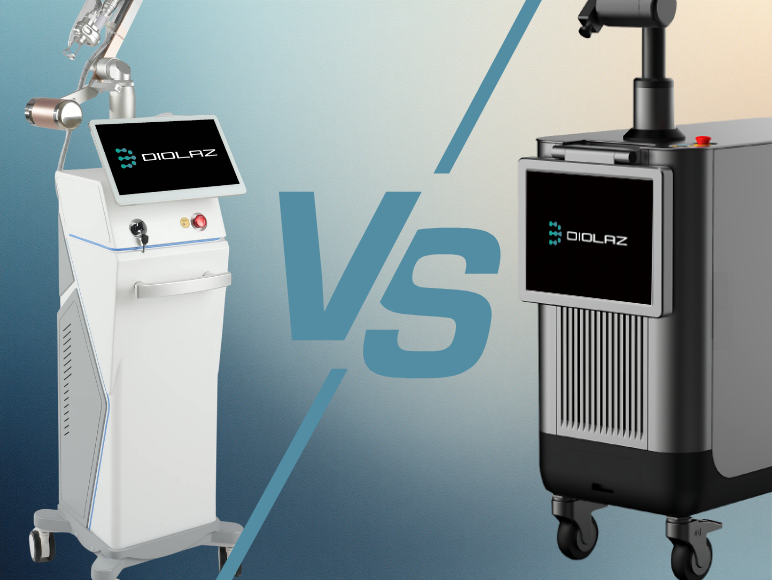
Le laser picoseconde DioLaz et le laser CO2 fractionné DioLaz sont tous deux des appareils avancés de rajeunissement cutané utilisés en médecine esthétique au Canada. Il est important de noter que ces deux outils ne sont pas interchangeables, malgré des capacités superposées en matière d'amélioration du teint et de la texture de la peau. Chaque laser fonctionne selon un principe distinct et excelle dans le traitement de différentes préoccupations cutanées. Les deux sont classés comme des dispositifs médicaux de classe III et homologués par Santé Canada, garantissant aux cliniques leur sécurité et leur efficacité testées. Pour les propriétaires de cliniques et les professionnels de la dermatologie, il est essentiel de comprendre les différences de mécanisme, d'applications cliniques et de temps de récupération des patients lorsqu'il s'agit de décider quel laser acheter (ou s'il faut investir dans les deux).
Mécanisme d'action : photomécanique vs ablatif
Laser picoseconde – Impulsions photomécaniques ultra-courtes : Le laser picoseconde DioLaz émet des impulsions ultra-courtes (~450 picosecondes) qui délivrent de l'énergie si rapidement que les particules de pigment et les cellules cibles sont brisées par un effet photomécanique (photoacoustique) plutôt que par la chaleur. Ce laser fonctionne à des longueurs d'onde de 1064 nm et 532 nm, ce qui le rend efficace pour l'encre de tatouage et la mélanine. Comme les impulsions picosecondes sont plus courtes que le temps de relaxation thermique des chromophores cutanés, elles confinent l'énergie à la cible et minimisent le chauffage collatéral. En pratique, cela signifie aucune ablation de l'épiderme – le laser ne vaporise pas la peau – ce qui entraîne aucune plaie ouverte et un temps d'arrêt minimal. Les ondes de choc acoustiques intenses non seulement fragmentent le pigment (par exemple, dans le mélasma ou les taches solaires), mais induisent également une réponse de cicatrisation dans le derme qui stimule la production de nouveau collagène et d'élastine. Cette stimulation du collagène est obtenue sans dommage superficiel, classant le dispositif picoseconde comme un laser non ablatif. Les patients ne ressentent généralement qu'une rougeur légère et transitoire car la couche externe de la peau reste intacte.
Laser CO2 fractionné – Resurfaçage ablatif : En revanche, le laser CO2 fractionné DioLaz est un système laser ablatif avec une longueur d'onde de 10 600 nm (dans la gamme infrarouge) qui est fortement absorbée par l'eau dans les tissus. Ce laser émet de l'énergie sous forme d'impulsions de microsecondes à millisecondes qui vaporisent des colonnes microscopiques de peau selon un motif fractionné. Chaque impulsion crée un minuscule canal d'ablation, éliminant les tissus épidermiques et dermiques superficiels endommagés et chauffant simultanément les tissus environnants. En délivrant un ensemble de ces micro-blessures entourées de peau intacte, le CO2 fractionné déclenche une réponse de guérison robuste avec un remodelage significatif du collagène tout en permettant à la peau intacte d'accélérer la régénération. Essentiellement, il « resurface » la peau : les rides et les cicatrices sont lissées à mesure que de nouvelles cellules de collagène et épidermiques remplacent les colonnes vaporisées par le laser. Ce processus ablatif produit un renouvellement cutané plus spectaculaire, mais au prix de la création d'une grille de plaies ouvertes qui nécessite un temps de récupération. L'administration fractionnée (par opposition à l'élimination ablative complète de toute la surface) contribue à réduire les risques et le temps d'arrêt, mais le traitement est toujours considéré comme agressif. La lésion mécanique et thermique des impulsions laser CO2 conduit à une contraction tissulaire immédiate (procurant un certain effet tenseur) et à une réorganisation à long terme des fibres de collagène à mesure que la peau guérit sur plusieurs semaines.
Applications cliniques et différences clés
En raison de ces mécanismes divergents, les lasers picoseconde et CO2 fractionné excellent dans différents scénarios cliniques :
-
Pigmentation et mélasma : Pour les lésions pigmentées bénignes (taches solaires, lentigos) et surtout le mélasma, le laser picoseconde est souvent le traitement de choix. Sa fragmentation non thermique du pigment évite d'exacerber le mélasma, une condition connue pour s'aggraver avec la chaleur et l'inflammation. En fait, l'utilisation d'un laser fractionné ablatif sur le mélasma peut entraîner le pigment plus profondément et déclencher une hyperpigmentation de rebond. L'approche douce du picoseconde est plus sûre pour les peaux plus foncées sujettes à l'hyperpigmentation post-inflammatoire. Les cliniques desservant des populations diverses (telles que les cabinets de Toronto avec des patients Fitzpatrick III-VI) comptent sur les lasers picosecondes pour les problèmes de pigmentation, car ils peuvent éclaircir l'hyperpigmentation avec un risque minimal et sans temps d'arrêt requis. Le laser CO2 fractionné, en revanche, n'est pas un traitement de première intention pour la pigmentation diffuse ou le mélasma, car sa lésion thermique peut provoquer les cellules pigmentaires. Il est préférable de le réserver aux améliorations de texture une fois que le pigment est sous contrôle.
-
Cicatrices d'acné et texture de la peau : Pour les cicatrices d'acné atrophiques et la texture rugueuse, les deux lasers ont un rôle à jouer, mais le CO2 fractionné est considéré comme la référence pour les cicatrices profondes. Les micro-colonnes ablatives du laser CO2 peuvent remodeler de manière significative le tissu cicatriciel déprimé et stimuler la production de nouveau collagène pour combler les cicatrices en creux. L'expérience clinique et la littérature montrent constamment une amélioration plus spectaculaire des cicatrices d'acné avec le CO2 fractionné par rapport aux méthodes non ablatives. Une séance de CO2 fractionné peut atteindre un niveau de révision des cicatrices qui pourrait nécessiter plusieurs traitements non ablatifs. Cependant, pour les cicatrices d'acné légères ou les patients qui ne peuvent pas supporter de temps d'arrêt, les lasers picosecondes (souvent avec un embout de lentille fractionnée) peuvent procurer un lissage progressif des cicatrices et des pores sur une série de séances. Les traitements picosecondes fractionnés ont également montré une amélioration des cicatrices atrophiques et des pores faciaux dilatés, bien que les résultats soient plus subtils et progressifs. En pratique, de nombreuses cliniques traitent les cicatrices d'acné modérées en alternant les deux technologies – en utilisant le laser picoseconde pour un tonifiant plus sûr sur les peaux plus foncées ou les cicatrices précoces, et en déployant le CO2 fractionné pour la subcision et le resurfaçage des cicatrices profondes chez les candidats appropriés.
-
Rides et photovieillissement : En ce qui concerne les rides, les ridules et le rajeunissement global de la peau, le laser CO2 fractionné offre à nouveau des résultats plus puissants par traitement. Les lasers fractionnés ablatifs (CO2 et erbium) sont toujours considérés comme la référence en matière de resurfaçage cutané et de réduction des rides. Ils éliminent physiquement les couches de peau vieillies et raffermissent le derme, produisant une amélioration notable des rhytides profondes et du relâchement cutané que les méthodes non ablatives ne peuvent égaler en une seule procédure. Les patients présentant des rides marquées, des dommages solaires importants ou un relâchement autour des yeux et de la bouche obtiennent généralement de meilleurs résultats avec le CO2 fractionné, bien qu'avec un certain temps d'arrêt. Les lasers picosecondes, étant non ablatifs, offrent une approche plus douce du photovieillissement : ils peuvent adoucir les ridules, éclaircir le teint et améliorer la texture de la peau progressivement en stimulant le collagène sans période de récupération. Par exemple, une série de séances de laser picoseconde peut rafraîchir un teint et réduire les fines rides périoculaires, ce qui plaît aux patients désirant un « soin laser du midi » sans séquelles évidentes. Dans les marchés urbains à revenus élevés comme Toronto, de nombreux professionnels optent pour un tel rajeunissement non ablatif afin d'éviter une semaine de congé. Néanmoins, les améliorations des traitements picosecondes sont plus subtiles et cumulatives, tandis que le CO2 fractionné produit un rajeunissement spectaculaire en un seul traitement au prix d'un temps d'arrêt. En somme, pour le photovieillissement avancé et les rides profondes, le laser CO2 est préférable, tandis que le laser picoseconde convient aux patients plus jeunes ou à ceux qui cherchent à maintenir la qualité de leur peau avec un minimum d'interruption.
-
Raffermissement de la peau et relâchement : Aucun des deux lasers n'est principalement un appareil de raffermissement de la peau comme le seraient le microneedling par radiofréquence ou les ultrasons, mais le CO2 fractionné a un léger avantage pour traiter le léger relâchement cutané. L'effet thermique des faisceaux CO2 provoque une contraction immédiate du collagène et un remodelage à plus long terme qui peut raffermir un léger affaissement (par exemple, un léger lifting des sourcils ou un raffermissement de la mâchoire). Les lasers picosecondes ont un effet tenseur immédiat minimal car ils reposent sur une énergie photomécanique plutôt que thermique, bien que le collagène produit au cours de plusieurs séances puisse subtilement améliorer la fermeté de la peau. Pour une clinique axée sur l'anti-âge, la capacité du laser CO2 à la fois à resurfacer et à raffermir en fait un outil de rajeunissement polyvalent. Le laser picoseconde, en revanche, excelle dans l'amélioration du teint (clarté, éclat) plus que dans un raffermissement significatif de la peau.
Considérations de sécurité et de temps d'arrêt
L'une des différences les plus frappantes entre ces lasers est le temps de récupération et le profil de sécurité pour le patient. Le laser picoseconde est un traitement non ablatif qui laisse l'épiderme intact, de sorte que le temps d'arrêt est minimal. Les patients ne ressentent généralement qu'une légère rougeur pendant quelques heures à une journée, sans suintement, sans desquamation significative, et le maquillage peut être porté dès le lendemain. Le risque de complications est très faible ; la courte durée des impulsions signifie que moins de chaleur est déposée dans la peau dans l'ensemble, ce qui réduit considérablement les risques de brûlures ou de changements pigmentaires. Cette sécurité est valable même pour les peaux plus foncées – les lasers picosecondes ont été utilisés avec succès chez les patients asiatiques et afro-américains pour des problèmes de pigmentation en raison de la faible incidence d'hyperpigmentation post-inflammatoire (HPI). En effet, le rajeunissement picoseconde non ablatif est devenu populaire en Asie pour cette raison. Tant que les réglages appropriés sont utilisés, le principal « effet secondaire » des soins du visage picoseconde est une rougeur semblable à un coup de soleil qui disparaît rapidement.
Le laser CO2 fractionné, étant une modalité ablative, implique une période post-traitement plus intensive. Même s'il ne traite que des fractions de la surface de la peau, les micro-zones traitées subissent un processus de guérison aigu. Le temps d'arrêt dure généralement environ 5 à 7 jours pour un traitement modéré, au cours duquel les patients présentent des rougeurs, une sensation de peau à vif et une desquamation bronzée des micro-points ablatés par le laser. L'œdème et un motif de « grille » de croûtes sont fréquents pendant la première semaine, à mesure que la peau ablatée se régénère. Des réglages plus intenses (densité ou énergie plus élevées) peuvent prolonger l'érythème pendant plusieurs semaines. Pendant la récupération, des soins attentifs des plaies sont nécessaires (nettoyage doux, émollients, évitement du soleil) pour assurer une bonne cicatrisation. Le risque d'effets secondaires est plus élevé avec le laser CO2, en particulier chez les patients ayant une peau olive à brune. L'hyperpigmentation post-inflammatoire n'est pas rare après le resurfaçage, surtout si une protection solaire stricte n'est pas observée pendant la guérison. Il existe également un faible risque d'infection ou de cicatrisation si des complications surviennent (bien que les dispositifs approuvés par Santé Canada comme DioLaz disposent de mécanismes de sikkerhet et de protocoles de formation pour atténuer cela). Une sélection appropriée des patients et un ajustement des paramètres du laser sont essentiels : pour les peaux plus claires (Fitzpatrick I–III) avec des photodommages ou des cicatrices graves, les avantages du CO2 fractionné l'emportent souvent sur le temps d'arrêt temporaire. Chez les patients à peau plus foncée, une approche conservatrice ou le choix du laser picoseconde (ou d'autres méthodes non ablatives) est prudent pour éviter les perturbations pigmentaires. En résumé, le laser CO2 offre un traitement plus agressif avec un temps d'arrêt significatif (environ une semaine de récupération) et nécessite une surveillance médicale pour les soins post-opératoires, tandis que le laser picoseconde offre une procédure pratiquement sans temps d'arrêt avec une excellente marge de sécurité.
Investir dans les deux : des avantages complémentaires pour une clinique
Pour une clinique canadienne tournée vers l'avenir, disposer à la fois d'un laser picoseconde et d'un laser CO2 fractionné peut permettre de traiter un large éventail de problèmes de peau. Plutôt qu'un appareil « remplaçant » l'autre, ils jouent des rôles complémentaires. Le laser picoseconde permet à la clinique de proposer des corrections rapides de la pigmentation, un rajeunissement doux et des traitements d'entretien qui attirent une clientèle exigeant des résultats mais ne pouvant pas interrompre leurs agendas chargés. Cela est particulièrement pertinent dans les zones métropolitaines comme Toronto ou Vancouver, où de nombreux patients recherchent des traitements non invasifs sans temps d'arrêt. Proposer des séances de laser picoseconde (pour le mélasma, l'hyperpigmentation post-acné, ou une série de soins laser pour l'éclat) peut devenir un service à volume élevé avec des visites répétées et une grande satisfaction des patients.
D'autre part, le laser CO2 fractionné permet à la clinique de s'attaquer aux changements de vieillissement et aux cicatrices plus graves que les appareils non ablatifs ont du mal à traiter pleinement. Une clinique capable d’effectuer un resurfaçage intensif si nécessaire – par exemple, traiter des cicatrices d'acné profondes chez un patient jeune, ou réaliser un lifting fractionné au laser pour un patient d'âge moyen présentant des rides – se distinguera comme une pratique esthétique à spectre complet. Souvent, une approche combinée donne les meilleurs résultats : un patient peut subir un resurfaçage au CO2 fractionné une fois pour des cicatrices importantes ou des rides marquées, puis passer à des séances de laser picoseconde pour l'entretien et l'affinage du pigment. Étant donné que les lasers picoseconde DioLaz et CO2 fractionné sont tous deux homologués par Santé Canada et conçus pour un usage professionnel, les cliniques peuvent être sûres de leurs normes de sécurité et de performance. D'un point de vue commercial, disposer des deux technologies diversifie le menu de traitements – attirant une clientèle plus large et permettant des soins plus personnalisés.
En conclusion, choisir entre un laser picoseconde et un laser CO2 fractionné n'est pas une décision binaire pour de nombreuses cliniques, mais plutôt une question de séquençage et de sélection des patients. Le laser picoseconde représente l'apogée du rajeunissement non ablatif et sans temps d'arrêt, idéal pour la pigmentation et la stimulation douce du collagène. Le laser CO2 fractionné reste la solution de poids lourd pour les besoins de resurfaçage, offrant des résultats transformateurs sur les cicatrices et le vieillissement que les lasers plus doux ne peuvent égaler. Pour les spas médicaux et les cabinets de dermatologie canadiens qui souhaitent offrir l'excellence sur tout le spectre des préoccupations cutanées, l'intégration des deux lasers est souvent la meilleure stratégie – en tirant parti des forces de chaque appareil pour offrir aux patients des résultats sûrs et efficaces adaptés à leurs objectifs et à leur mode de vie.
Références
-
Kroma-Szal, A. et al. (2025). Medical Applications of Picosecond Lasers for Removal of Non-Tattoo Skin Lesions – A Comprehensive Review, Applied Sciences, 15(9):4719. pp. 1024–1032, 1031–1037.
-
Zhou, Y. et al. (2023). An update on fractional picosecond laser treatment: histology and clinical applications, Lasers Med. Sci. 38(1):45. p. 175–183 (Abstract).
-
Chwalek, J. (2016). Dermatologue certifié – Questions-réponses sur « CO2 fractionné vs PicoSure Focus pour les cicatrices d'acné ? » RealSelf (12 octobre 2016). Extrait de réponse.
-
Davin Lim, D. (2020). Dermatologue spécialisé – Suivi questions-réponses sur le CO2 fractionné vs le picoseconde (pour les peaux ethniques), RealSelf (1er déc. 2020). Extrait de réponse.
-
B. Aesthetic Clinic (2026). Laser Pico vs Laser CO2 fractionné : Lequel est le meilleur ? – Guide 2026. BestAestheticSpecialistMalaysia.com. Tableau comparatif et analyse.
-
Green, M. (s.d.). Laser fractionné pour le mélasma – Section Q&A, site Web du Dr Michele Green M.D. (NYC). Explication du mélasma et des lasers.
Partager:
Laser picoseconde DioLaz 450ps : une avancée technologique en matière de détatouage
1064nm + 532nm Double Longueur d'onde : Le Pico Laser Efface Toutes les Couleurs de Tatouage