
The Buying Question Behind the Word “Pico”
Most clinic owners have noticed that “Pico” is one of the most overused terms in aesthetic-device marketing. The real question is whether the quoted system delivers documented picosecond-domain pulses or is simply a lower-cost nanosecond Q-switched laser with more polished branding. Two devices may advertise the same 1064 nm and 532 nm wavelengths while operating in very different pulse-duration ranges, so wavelength alone does not prove that a system is truly picosecond. That distinction influences pigment fragmentation, thermal diffusion, consultation quality, and the credibility of a premium treatment menu.
Start With Documented Pulse Duration
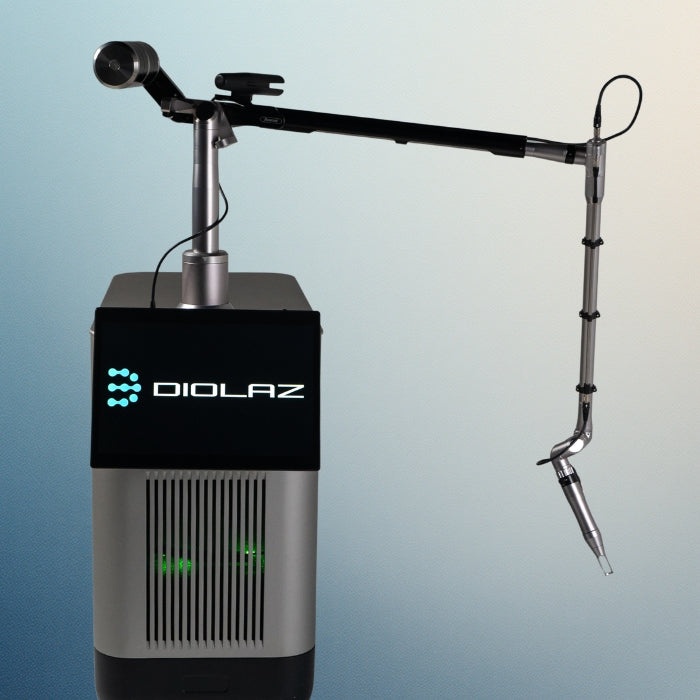
DioLaz Canada’s official materials document a dual-wavelength 1064 nm and 532 nm platform with a 450 ps pulse duration, 1–10 Hz repetition rate, a 2–10 mm adjustable spot size, two treatment heads, and articulated-arm beam delivery. At 450 ps—less than one nanosecond—the pulse duration is stated clearly rather than hidden behind broad language such as “ultra-fast.” All DioLaz devices are Health Canada licensed. The PICOSECOND LASER SYSTEM is licensed as a Class III medical device under Health Canada Medical Device Licence No. 115451. For Canadian clinic owners, that combination of technical and regulatory documentation is more useful than an unsupported “medical grade” claim.
Why Picoseconds Change the Clinical Conversation
Conventional nanosecond Q-switched lasers remain established tools for tattoo and pigment treatments. A true picosecond platform, however, compresses energy into a much shorter pulse window. This shifts more of the treatment effect toward photomechanical disruption rather than prolonged heat diffusion. Clinical literature has reported successful and rapid treatment of challenging blue and green tattoo pigment with picosecond technology (Brauer et al., 2012). That does not make every case simple, but it gives clinics a scientifically defensible reason to distinguish documented Pico hardware from budget nanosecond systems.
A Broader Service Line Creates Stronger Differentiation
Dual wavelengths also matter. DioLaz positions 1064 nm for deeper pigment and darker tattoo inks, while 532 nm supports more superficial pigmentation and brighter ink colours. The 2–10 mm adjustable spot size gives operators flexibility for more precise work and broader treatment areas. The system is positioned for tattoo removal, pigmented lesions, and skin rejuvenation. A clinic that can address several patient journeys with one platform is building a service line, not a single promotional treatment. That makes staff training, consultation scripting, scheduling, and long-term marketing more coherent.
Make Documentation the First Procurement Filter
Medical directors should also consider the credibility of the answer they give when a patient asks why one platform was selected over another. “It was the cheapest quote” is not persuasive. “It has a documented 450 ps pulse duration, dual wavelengths, a Canadian medical device licence, and a defined professional workflow” is. That explanation supports informed consultations, realistic expectations, and stronger staff confidence.
Before comparing purchase prices, verify four things: the pulse duration is documented in picoseconds; the Canadian licence is current and device-specific; the wavelengths fit the clinic’s intended treatment mix; and the supplier provides meaningful clinical and safety guidance. Clinics that reverse that order may save on acquisition cost and pay for it later through weak differentiation, difficult training, or inconsistent patient confidence. That sequence protects not only clinical credibility, but also the margin and reputation attached to every treatment sold.
CLINIC-OWNER TAKEAWAY
Buy the evidence, workflow, and regulatory confidence—not the word “Pico” printed on the casing.
Next step for clinic owners: Explore the DioLaz Picosecond Laser and verify Health Canada Medical Device Licence No. 115451.
References
2. Health Canada. (2026). Medical Device Licence No. 115451: PICOSECOND LASER SYSTEM.
3. Brauer, J. A., Reddy, K. K., Anolik, R., et al. (2012). Successful and rapid treatment of blue and green tattoo pigment with a novel picosecond laser. Archives of Dermatology, 148(7), 820–823.
4. Barua, S. (2015). Laser-tissue interaction in tattoo removal by Q-switched lasers. Journal of Cutaneous and Aesthetic Surgery, 8(1), 5–8.
5. Kuperman-Beade, M., Levine, V. J., & Ashinoff, R. (2001). Laser removal of tattoos. American Journal of Clinical Dermatology, 2(1), 21–25.
Share:
How Diode Hair Removal Builds Predictable Recurring Clinic Revenue
What Canadian Clinic Owners Should Verify Before Buying Pico Lasers