
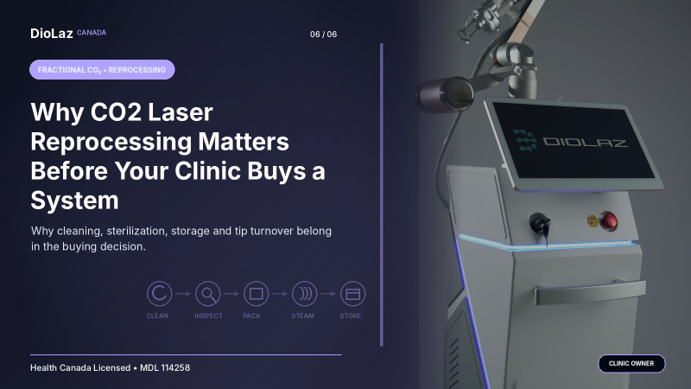
The Buying Question Behind “Reusable Handpieces”
A reusable component does not eliminate operating work; it moves that work into reprocessing. Before a clinic buys a CO₂ laser, the owner should know which parts contact the client, which parts require cleaning and sterilization, how long the complete cycle takes, and how many ready components are needed to support the appointment schedule.
This is more than an infection-control detail. Reprocessing affects staffing, room turnover, storage, instrument inventory and the number of procedures the clinic can complete without rushing a required step.
Different Components Require Different Handling
The DioLaz Fractional CO₂ Laser User Manual separates the removable treatment tips from the rest of the handpiece and articulated arm. It instructs users to remove visible contamination, clean and dry the applicable tip, package it for vacuum steam sterilization, and store it where it will not be re-contaminated. The stated reference cycle for the non-fractional tip is 132°C for four minutes, followed by a 20-minute drying time.
The remaining handpiece and arm follow a different pathway: cleaning, low-level disinfection and drying, with sterile disposable sheathing used where specified. The fractional tip must be cleaned and steam sterilized before use on each client. These steps should be read directly from the current manual and incorporated into the clinic’s validated local process; they should not be replaced by a generic “wipe between clients” rule.
Cleaning Comes Before Sterilization
Sterilization is not a shortcut around soil removal. Andersen and colleagues studied contaminated dental turbine chambers and concluded that cleaning before steam sterilization was essential for safe reprocessing. The instrument was different, but the principle applies broadly to complex reusable devices: retained material can interfere with the process.
Costa and colleagues examined surgical instruments that had undergone repeated use and processing. Although cultures were negative, microscopy identified biofilm on four of eight instruments and visible soil or damage on all instruments examined. Their findings do not evaluate DioLaz handpieces, but they show why visual inspection, cleaning quality and retirement criteria matter even when an item has completed a sterilization cycle.
Calculate Turnover Before Opening the Schedule
Map the full path: point of use, safe transport, pre-cleaning, cleaning, inspection, drying, packaging, sterilization, drying, release and clean storage. Then compare the cycle time with your booking pattern. One tip may be technically reusable yet operationally unavailable while it is being processed.
Ask how many tips are supplied, whether additional compatible tips can be ordered, how damaged optics or surfaces are identified, and who is trained to release a processed item for use. Also confirm that the clinic’s sterilizer and packaging process are appropriate for the device instructions and local standards. A rushed cycle is not a capacity strategy.
Make Reprocessing Part of Procurement
During a demonstration, request a component-by-component walkthrough rather than a verbal assurance that cleaning is “easy.” Review disassembly, inspection points, approved materials, packaging, storage and documentation. Include reprocessing supplies and staff time in the launch budget, along with protective eyewear and plume management.
Across DioLaz’s professional laser portfolio, the Diode, Fractional CO₂ and Picosecond systems are each Health Canada licensed: Diode MDL 114257, Fractional CO₂ MDL 114258, and Picosecond MDL 115451.
|
CLINIC-OWNER TAKEAWAY Buy the reprocessing workflow with the laser. Adequate tip inventory, trained staff, clean storage and protected processing time are what turn reusable components into reliable clinical capacity. |
Next step for clinic owners: explore the DioLaz Fractional CO₂ Laser and ask for the current user-manual reprocessing workflow before finalizing staffing, sterilizer capacity and appointment turnover.
References
2. DioLaz Canada Inc. (n.d.). Fractional CO2 Laser Therapy System: User manual.
Share:
SHR vs HR Diode Laser Modes for Efficient Aesthetic Clinic Workflows